Interview with Antoni Dżumaga, a Madcap expert with Polish roots

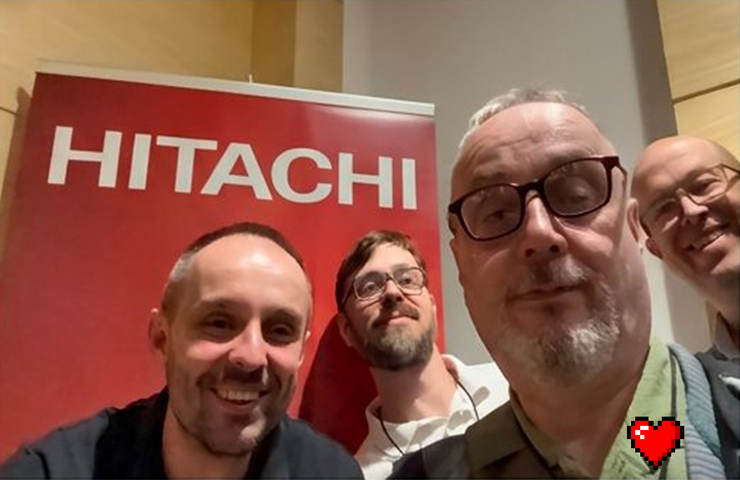
Our guest today is Antoni, who is at the forefront of the title image (with red heart annotation), surrounded by Piotr Sroka, me, and Tim Temme.
Antoni made extensive contributions as technical writer. He possesses expert knowledge of documentation tools and knows how to automate processes. I met him at Cake Conf 2026, and enjoyed many conversations with him.
In this interview, we explore his career and ask for his perspective on the world of technology.
Hello Antoni!
Thank you for taking part in this interview
Let's start on a personal note. What is your relation to Poland?
My father was Polish and emigrated to the UK during WWII, and my mother was Italian. We spoke only Polish and Italian at home until I was 11 years old. I went to a Polish school in the evenings and at weekends, studying all the usual subjects you would at any school. My father didn’t speak about the war and couldn’t bring himself to return, so I visited Poland for the first time in my life for the Cake conference and immediately felt at home, with the food, the language, and the country. The visit was long overdue.
How did you discover technical communication?
Having qualified in programming I initially took a different path, building a career in retail management within a Sony Centre, an Apple Centre and then Escom, selling personal computers. Two of these roles ended abruptly when I arrived at work to discover that the businesses had ceased trading, with no prior notice, or redundancy. After some career guidance, I looked for work in technical writing.
This proved to be a natural progression, bringing together my technical knowledge, commercial experience and ability to understand technology from the customer's perspective. When an opportunity arose to secure a role requiring knowledge of Scitor's software suite, I took the initiative to teach myself the software and successfully demonstrated my understanding. This experience established a pattern that would serve me throughout my career: identifying opportunities, mastering complex software and translating technical knowledge into practical value.
How did your career progress?
Moving into technical writing was a real reawakening. I had found a role that combined technology, communication and the challenge of making complex subjects accessible to others. Creating courseware and online help for corporate, defence and financial institutions brought a new level of challenge and professionalism.
I gained a great deal of experience and decided to formalise my knowledge with professional qualifications. I obtained a City & Guilds Certificate in Technical Writing and Communication and a Chartered Institute of Personnel and Development (CIPD) Certificate in Training Practice.
My subsequent roles took me into a variety of industries, including a luxury yacht company, where I wrote user manuals; the oil and gas industry, documenting supervisory control and data acquisition (SCADA) software; and digital marketing, where I developed online help for marketing software.
In which areas of technical writing do you feel strongest?
My strengths lie in understanding technical content and communicating it visually.
What do you consider your biggest achievements?
My programming and systems background gave me a problem-solving mindset and an eye for process improvement. I moved the luxury yacht documentation content into a database and used XML with FrameMaker to single-source the content, saving over £100,000 a year in translation costs and reducing manual production time from weeks to a few days.
Throughout my career, I used systems thinking and coding to streamline processes and monitor quality. This allowed me to improving the quality of my work, develop new skills and refine processes. The result was highly professional print and online documentation that significantly improved the user experience.
Who would you recommend this career path to?
I would recommend this career to anyone who enjoys continually learning, solving problems and making complex things easier to understand. Good planning and organisation are essential, as deadlines can be tight and documentation is often needed towards the end of a development phase.
What areas are you currently exploring, and in what direction do you plan to develop?
My strengths lie in understanding complex systems, planning information structures and finding ways to make technical content more effective through automation and process improvement. I’m also exploring how AI can support and enhance these areas. I’m interested in building on my extensive technical writing experience in a role where I can combine systems thinking, visual communication and emerging technologies to improve how technical information is created, maintained and understood.
How can senior management support documentation teams?
Investing in the right documentation systems and technologies can also reduce translation and maintenance costs, improve consistency, and accelerate the delivery of updates across multiple formats and languages.
Documentation teams should be given opportunities to attend technical conferences in person, where they can collaborate, share ideas and learn from their peers, bringing new approaches and efficiencies back into the business.
How do you currently perceive the job market and trends affecting the role of a technical writer?
Although I haven’t fully re-entered the job market, I can see that technical writing is facing a period of significant change. The pace of technological development presents challenges, and AI is likely to be reshaping both the job market and the skills employers value.
I believe the ability to adapt, understand emerging technologies and apply them effectively will be increasingly important for technical writers.
What advice would you give to candidates who want to join documentation teams?
Look for an organisation that invests in continuous professional development and has a strong development process that treats technical documentation as an integral part of product development, rather than an afterthought.
Did you work in an international team, and what advantages or challenges does that bring?
I worked as part of an international team spanning India, Manila and the US, while coordinating the work from the UK. When planned well, this arrangement allowed work to progress around the clock, making effective use of the different time zones.
The main disadvantage was the lack of regular face-to-face contact, which I believe adds considerable value to teamwork and collaboration. However, management recognised its importance and ensured that we all met in person at least once a year.
What are the strategies for sole writers?
Being the sole technical writer is a demanding role that extends far beyond content creation. It requires strong organisational and project management skills, effective use of automation to streamline workflows, close collaboration with subject matter experts (SMEs), and robust review processes to ensure accuracy and quality.
Establishing an effective workflow takes time, particularly when you are constantly trying to keep pace with development. It is essential to make time for process improvement and proactive planning, rather than becoming trapped in a cycle of reactive delivery.
Do you use AI? What is your company’s approach towards it?
I use AI tools, although I’m not currently working for a specific company. In a work environment, I would use AI to reduce repetitive tasks and help manage processes through automation. However, I would never rely on AI-generated content without checking it carefully. I would also continue to use the automations I had developed myself, as I knew them to be 100% reliable.
Is documentation work a long-term career, or rather a stepping stone to other IT roles?
Technical documentation can be a long-term career in its own right, particularly if you vary your roles and continue to develop new skills to keep the work interesting. I’ve worked in the field for 25 years, and it can be a very rewarding and lucrative career in the right role. It can also provide a springboard into related disciplines, such as UX design or Product Management.
What seems obvious to you but is not understood by other teams working with documentation teams?
My impression is that AI is dominating discussions at the moment, while topic-based authoring, structured documentation and established writing best practices are receiving less attention. This is based on my observations at the Cake Conference rather than direct experience, so I can’t say whether this reflects the wider industry. However, I believe these fundamentals remain essential, regardless of how the technology evolves.
Has working in documentation changed or influenced your life in any way?
I’ve had the opportunity to explore some fascinating worlds, from project management and process improvement on exciting projects I can’t talk about, to the luxury yacht industry, which was great fun. Working with metering remote terminal units (RTUs) in the oil and gas industry also taught me a great deal about electronics.
What conferences do you attend? Do you participate as an attendee or as a speaker?
I’ve attended Technical Communication UK (TCUK) since 2012, as well as MadWorld in Prague and Dublin, TC Europe and Cake Conf. I’ve also presented at TCUK on the use of SVG in technical documentation.
What is the one thing you would change in your company, if it were possible?
Eliminate MS Word from the technical documentation process and adopt tools designed specifically for creating, managing and publishing technical content.
What tools do you use for technical writing, which operating systems do you work with, and what software would you like to see developed specifically for Mac?
I use MadCap Flare and would like to see it made available for the Mac. Almost all Markdown platforms are already available for the Mac.
What are your interests outside of work? How do you like to spend your free time?
I enjoy hands-on creative pursuits such as bookbinding and woodworking, as well as travelling to places rich in natural beauty or history. Family is important to me, and I also enjoy making time for leisure and cultural experiences, particularly live music and theatre.